Genesis 1-11 – Chapter 1

Genesis 1-11 – Chapter 1
The Architecture of Beginnings: Understanding the Structural Triumph of Genesis 1–11
When modern readers open the pages of the Old Testament, they are immediately confronted with a literary masterpiece that has shaped civilisation for millennia: Genesis 1-11.
Often referred to by biblical scholars as the Primeval History, these eleven chapters serve as the foundational prologue not just to the Book of Genesis, but to the entire biblical narrative.
Far from a disorganised collection of ancient folklore, the opening movements of Genesis are a meticulously designed, highly structured theological argument.
To truly understand Genesis 1-11, one must look past modern debates about material origins and instead peer through the lens of ancient Near Eastern literature.
When we do, we discover a brilliant cosmic blueprint—one where an eternal Creator systematically conquers chaos, builds a home for humanity, and relentlessly pursues order and relationship.
Day 1 and the Sovereignty of Yahweh Over Time
The very first movement of Genesis establishes a cosmic baseline that is starkly different from contemporary creation myths of the ancient world. Verse 2 notes that before the creative words of God echoed across space, the condition was one of tohu va-bohu—formless, empty, and blanketed in darkness.
“Now the earth was formless and empty, darkness was over the surface of the deep…” — Genesis 1:2
In ancient cosmology, darkness and the deep waters represented chaos, non-existence, and the terrifying absence of order.
This darkness was the pre-creation position.
Crucially, the text does not depict Yahweh battling this darkness. Instead, He exists entirely outside of it.
Because Yahweh is transcendent, He is outside of time itself.
He is the author of Space, Matter, and the Cosmic Clock.
On Day One, when God speaks light into existence, He isn’t merely turning on a cosmic lightbulb; He is inventing time as human beings know it. By adding daytime to the preexisting darkness of night, Yahweh initiates the rhythm of evening and morning.
He subdues the chaotic, static baseline of darkness by introducing the dynamic sequence of time.
This establishes a profound theological principle that reverberates through the rest of Genesis 1-11 and into the modern world: light is an intrusive, active agent added to darkness.
Darkness has no inherent power to push back; it simply must yield when the Creator speaks. It is a pattern of divine intervention that remains active on Earth today, both in the planet’s physical spin and in the spiritual renewal of the human heart.
The Symmetric Blueprint: Forming and Filling (Days 1–6)
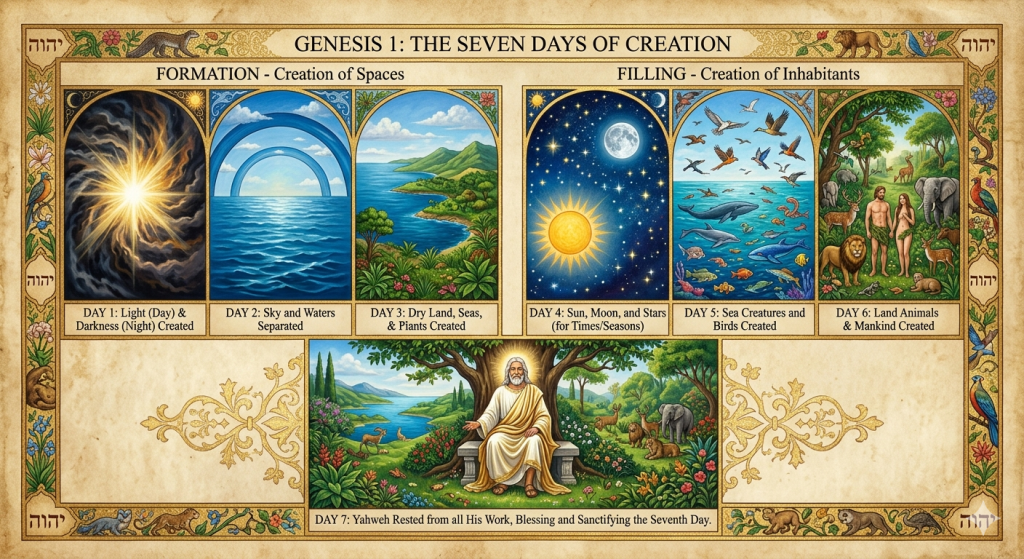
As the narrative of creation progresses through the first week, the author utilises a brilliant poetic structure often called a double triad. This literary framework breaks the six days of labour into two distinct movements:
Days 1 through 3 focus on creating spaces (forming), while Days 4 through 6 focus on filling those spaces with inhabitants.
This intentional symmetry demonstrates that Yahweh is an architect of supreme order. He does not scatter life into a vacuum; He builds the home before moving the family into it.
The Realms Created (Days 1–3)
- Day 1: God separates light from darkness, structuring the realm of Time.
- Day 2: He separates the waters above from the waters below using an expanse, carving out the realms of Sky and Sea.
- Day 3: He gathers the waters underneath the sky so that dry ground appears, establishing the realm of Land and Vegetation.
The Realms Filled (Days 4–6)
- Day 4: God populates the realm of Time. He places the sun, moon, and stars in the sky to govern the day and night and to track seasons and years.
- Day 5: He populates the Sky and Sea, commands birds to fly across the expanse, and fills the deep oceans with swarming marine life.
- Day 6: He populates the Land, commanding it to bring forth livestock, wildlife, and ultimately, humanity—made in the divine image to rule and steward the newly furnished creation.
By the time Day Seven arrives, the cosmic temple is both completely formed and richly filled, allowing Yahweh to rest and rule over a perfectly ordered universe.
The Macro-Structure: The Rhythm of Genesis 1–11
The structural genius of Genesis 1-11 doesn’t end with the creation week.
The entire eleven-chapter prologue is held together by a recurring literary hinge known as the toledot formula, traditionally translated as “these are the generations of…” or “this is the account of…”
This phrase occurs five times in these opening chapters, acting as a camera zoom that transitions the reader from the cosmic scale down to specific human lineages.
It sets up a fascinating, cyclical rhythm of divine blessing, human rebellion, cosmic de-creation, and merciful recreation.
| Scripture Passage | The Toledot Focus | Cosmic / Theological Theme |
| Genesis 2:4 | Heavens and the Earth | Ideal creation, order, and intimate relationship. |
| Genesis 5:1 | Family Line of Adam | The spread of humanity alongside the entry of mortality. |
| Genesis 6:9 | The Account of Noah | Human violence breaks the land; God enacts de-creation via the Flood. |
| Genesis 10:1 | Sons of Noah (Table of Nations) | The scattering and repopulating of the Earth post-flood. |
| Genesis 11:10 | Family Line of Shem | The narrowing of the focus toward Abraham and the rescue plan. |
From Creation to Babel: The Anatomy of De-Creation
When analysing Genesis 1-11 as a cohesive whole, a clear trajectory emerges. God creates a space of perfect order, but humanity continually introduces ethical and spiritual chaos back into that space.
In Genesis 3, the temptation in the Garden is fundamentally an attempt to hijack God’s role as the definer of order (good and evil).
By Genesis 6, human wickedness has grown so pervasive that the text laments the state of the ground.
The flood of Noah is not just a rainstorm; it is an act of de-creation. God pulls back the boundaries He set up on Day 2, allowing the chaotic waters above and below to collapse back together, returning the earth to its dark, watery, pre-creation baseline.
Yet, because Yahweh is a God of restoration, the flood recedes, the dry land appears again (an echo of Day 3), and Noah steps off the Arc to repeat the command to “be fruitful and multiply.”
The climax of human autonomy in this section occurs at the Tower of Babel in Genesis 11.
Here, humanity attempts to build a tower to the heavens, not to worship the God who sits outside of time, but to “make a name for themselves” and prevent being scattered across the spaces God designed them to fill.
Once again, Yahweh steps in to confuse their languages, forcing them to fulfil the original cultural mandate of filling the earth.
Conclusion: The Launchpad of the Biblical Narrative
Without the structural and theological foundations laid out in Genesis 1-11, the rest of the biblical library loses its anchor.
These chapters tell us who God is: the sovereign Creator who exists outside of time, the architect who transforms dark voids into structured spaces, and the artist who fills those spaces with vibrant life.
Though humanity continuously attempts to fracture the order God established, Genesis 1-11 proves that darkness never has the final word.
The prologue closes by tracing a thin genealogical line through the default chaos of a scattered world, landing precisely on an aging, childless nomad named Abram.
Through him, the God who spoke light into existence on Day One would launch a historic rescue mission to reclaim, reform, and refill His creation once again.
Read what Answers in Genesis has to say about Genesis 1-11.