

Genesis 4 Commentary: The Illusion of Autonomy

Genesis 4 Commentary: The Illusion of Autonomy
Self-Worship, and the Blueprint of Babylon
Read the BibleHub Genesis 4 Commentary.
Listen to the podcast episode from this link.
Genesis 4 commentary is rarely approached with the structural and theological gravity it demands.
In popular culture and superficial commentary, the narrative of Cain and Abel is frequently reduced to a tragic, localised story of sibling rivalry, remembered primarily as the world’s first murder.
However, when evaluated within the cohesive framework of the entire Biblical canon, Genesis 4 emerges as a foundational and cosmic blueprint. It establishes the trajectory of the human empire, exposes the myth of human neutrality, and outlines the perpetual struggle between divine ownership and self-deification.
To understand Genesis 4 is to understand the modern human condition. As a race, humanity has not changed since the Garden of Eden. The architectural lines drawn from the blood of Abel lead directly to the heights of the Tower of Babel, culminating ultimately in the global system of “Babylon the Great” detailed in the Book of Revelation.
This commentary will analyse the text through the lens of absolute divine sovereignty, the reality of human ownership, and the immutable standards of Yahweh.
The Worshiper in the Mirror: The True Identity of Cain’s Devotion
A critical entry point to Genesis 4, which standard commentaries often overlook, is the protagonist’s religious status.
Cain was not an atheist. He was not a secular materialist, nor was he a pagan practising overt idolatry to a foreign pantheon. The text notes that Cain brought an offering directly to Yahweh. He operated within the same theological reality as his father, Adam.
This detail carries profound theological weight: religious observance is no guarantee of a right heart.
The issue was never Cain’s lack of belief in God; the issue was the object of his ultimate devotion. When Yahweh looked favourably upon Abel and his offering but rejected Cain and his offering, Cain did not engage in self-reflection or repentance. Instead, his countenance fell, and he became fiercely angry.
His reaction unmasks the true nature of Cain’s devotion. His worship was entirely conditional, structured around what he expected to receive or how he expected to be validated. When God did not comply with Cain’s self-dictated terms, Cain’s true deity was revealed to be himself. He allowed his ego, his pride, and his resentment to override the Creator’s explicit instructions.
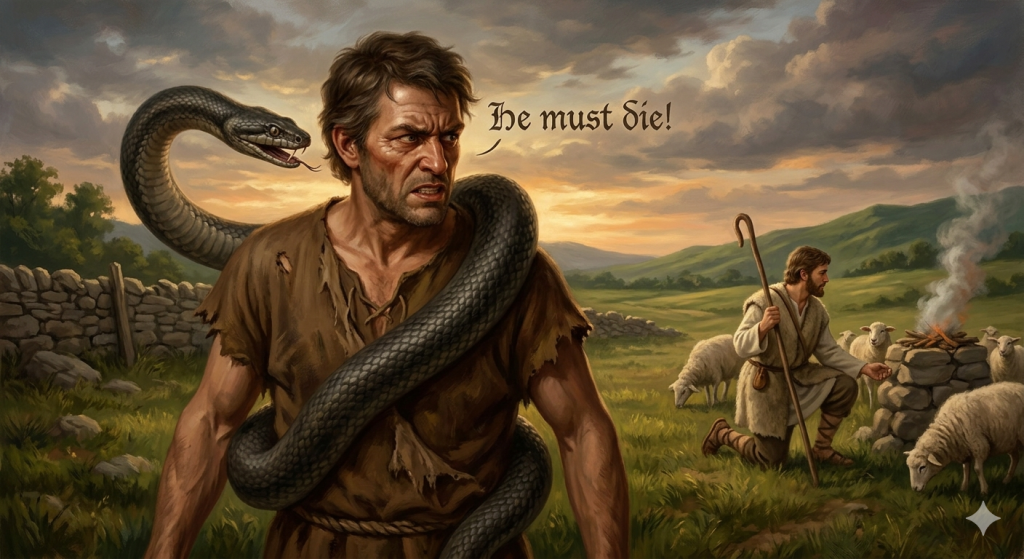
This mirrors the mechanics of the Fall in Genesis 3. The serpent in the Garden is not a zoological lesson; it represents a profound portrayal of mankind’s internal vulnerability to self-worship. The ultimate temptation delivered by the serpent was not the mere consumption of fruit, but the intoxicating promise:
“…you will be like God, knowing good and evil.” (Genesis 3:5)
In the original Hebrew context, “knowing” (yada) implies far more than cognitive awareness; it signifies the authority to determine, legislate, and dictate.
The original temptation was for humanity to usurp the throne of God and become the ultimate arbiters of right and wrong. Cain succumbed completely to this internal serpent. When his independent terms were rejected by Yahweh, he chose to dictate his subsequent actions himself, demonstrating that his heart belonged to his own ego rather than to the Almighty.
The Principle of the Firstfruits: First and Best vs. Leftovers
To fully comprehend why Abel’s offering was accepted and Cain’s was rejected, one must examine the specific text describing their sacrifices. Genesis 4:3–4 states:
Genesis 4:3-4 LSB So it happened in the course of time that Cain brought an offering to Yahweh of the fruit of the ground. (4) Abel, on his part, also brought of the firstborn of his flock and of their fat portions. And Yahweh had regard for Abel and for his offering;
The contrast is structural and qualitative.
Abel brought the firstborn and the fat portions, representing the absolute first and best of his produce. This was an act of profound faith, recognition, and surrender. By giving the first fruits, Abel was declaring that Yahweh was the source of all life and sustenance, trusting that God would provide for the future.
Cain, conversely, brought “some of the fruits of the soil” in the course of time. The phrasing implies a casual, secondary action. Cain brought what was left over. He did not honour God with the first of his harvest; he maintained his personal security first and offered the remainder to Yahweh.
Today, nothing has changed. The human inclination remains identical: humanity routinely offers God its leftovers, such as leftover time, leftover finances, leftover energy, and leftover devotion, while retaining the primary, best portions for the self.
Yahweh is immutable.
Malachi 3:6 states, “I the Lord do not change.” Because His character, His holiness, and His sovereignty are completely unalterable, His standards remain absolute. He is not a deity who can be bought off with residual attention or secondary efforts. He demands, and explicitly deserves, our first and best every single day.
The moment a human being shifts from surrendering the first fruits to calculating what portion can be safely spared, they cross the threshold into self-governance. As soon as we self-dictate our actions, determining for ourselves what constitutes an acceptable sacrifice, sin is immediately crouching at the door.
The Myth of Autonomy and the Two Masters
A central pillar of Genesis 4 is the explicit warning God provides to Cain before the murder takes place:
“If you do not do what is right, sin is crouching at your door; it desires to have you, but you must rule over it.” (Genesis 4:7)
Modern secular philosophy and contemporary theology often distort this passage to support the myth of absolute human autonomy, the idea that human beings occupy a neutral, independent middle ground from which they can freely choose between good and evil without external ownership.
Scripturally, however, this neutral territory does not exist. The human will is never operating in a vacuum; it is always owned, always captive to a master.
When God warns Cain that sin is crouching at his door, He uses predatory language. Sin is depicted as an active, living force seeking total domination (tešuqah). God is informing Cain that if he does not submit to divine order, he will not remain a free, independent agent; rather, he will be claimed and occupied by an alternative master.
Cain’s subsequent murder of Abel was not an isolated, independent act of free will. It was the physical manifestation of a spiritual alignment. By killing his brother, Cain executed the desires of the adversary. This binary reality is confirmed explicitly by Jesus Christ thousands of years later during His confrontation with the religious elite in the Gospel of John:
“You belong to your father, the devil, and you want to carry out your father’s desires. He was a murderer from the beginning, not holding to the truth, for there is no truth in him.” (John 8:44)
Jesus explicitly links the spirit of murder back to its cosmic origin, identifying Satan as the murderer from the beginning. Cain became the hands and feet of that foundational lie because his heart was claimed by that alternative master.
There is no middle ground. Our wills are owned either by Satan or by Jesus Christ.
When an individual rejects the ownership of Jesus, they automatically default into the ownership of the enemy.
The Structural Line to Babylon: The First City and Human Civilisation
Following the execution of Abel, Yahweh pronounces judgment upon Cain, condemning him to be a restless wanderer on the earth.
Cain’s response is telling.
He panics over his lost security, fearing that without divine protection, he will be killed by others. Although God provides a protective mark, Cain immediately attempts to resolve his insecurity through human effort.
Genesis 4:17 records the immediate consequence of Cain’s exile:
“Cain was then building a city, and he named it after his son Enoch.”
In the overarching narrative of Scripture, the construction of the first city by the first murderer is deeply symbolic. Human-built cities, beginning with the city of Enoch, frequently represent humanity’s collective effort to establish security, identity, and independence apart from God. Finding himself alienated from the soil and from the presence of the Lord, Cain constructs an artificial environment to protect himself, naming it after his own lineage to secure his legacy.
From this point, Genesis 4 tracks the rapid technological and cultural advancement of Cain’s descendants:
- Jabal: The father of those who live in tents and raise livestock, representing agricultural scaling.
- Jubal: The father of all who play stringed instruments and pipes, representing cultural and artistic development.
- Tubal-Cain: A forger of all kinds of tools out of bronze and iron, representing industrial and military metallurgy.
This catalogue demonstrates that technological and cultural progress frequently run parallel to severe moral decay. Human civilisation scales its capacity to manipulate the physical world, but without submission to Yahweh, it simultaneously scales its capacity for arrogance and destruction.
This decay culminates in Lamech, Cain’s great-great-great-grandson. Lamech does not merely duplicate Cain’s sin; he escalates it into a point of pride. He composes a poem boasting to his wives about murdering a young man for merely wounding him:
“If Cain is avenged seven times, then Lamech seventy-seven times.” (Genesis 4:24)
Lamech takes the protective decree that God sovereignly placed on Cain and usurps it, claiming a self-dictated right to absolute vengeance. This is the ultimate manifestation of the serpent’s promise, showing human beings asserting themselves as completely autonomous sovereigns who determine life, death, and justice by their own hand.
Man builds for security. “Let us make a name for ourselves.” The ultimate system of human hubris.
This structural line moves directly from the city of Enoch to Genesis 11 with the construction of the Tower of Babel. At Babel, collective humanity utilises their unified technological advancement to explicitly declare: “Come, let us build ourselves a city, with a tower that reaches to the heavens, so that we may make a name for ourselves…” (Genesis 11:4). This is the literal birth of Babylon, the institutionalisation of human self-worship on a geopolitical scale.
This trajectory continues uninterrupted through human history until it reaches its final, cosmic expression in Revelation 17 and 18. “Babylon the Great” is the ultimate, mature manifestation of the seed planted by Cain. It is the global, multi-generational system of economic exploitation, military arrogance, and cultural seduction that operates in total defiance of the Creator. Kingdoms rise and fall precisely because they are constructed upon this volatile, broken foundation of human hubris and self-deification.
God’s Absolute Sovereignty: The Execution of Plan A
When evaluating the catastrophic failures recorded in the early chapters of Genesis, such as the fall of Adam, the murder of Abel, and the terrifying arrogance of Lamech, it is easy for a superficial reader to conclude that human history is a chaotic series of panic-induced course corrections by a frustrated Creator. This perspective assumes that human sin routinely forces God to abandon His original designs and formulate a hasty “Plan B.”
The text of Genesis 4, supported by the entirety of prophetic scripture, shatters this premise. Yahweh possesses absolute omniscience and sovereignty. He is never reactionary; He is entirely proactive. Cain’s rebellion did not catch the Creator off guard, and Abel’s death did not disrupt His cosmic timeline.
This immutable truth is anchored definitively in the words of the prophet Isaiah:
Isaiah 46:9-10 LSB “Remember the former things long past, For I am God, and there is no other; I am God, and there is no one like Me, (10) Declaring the end from the beginning, And from ancient times things which have not been done, Saying, ‘My counsel will be established, And I will accomplish all My good pleasure’,
Yahweh makes known the end from the very beginning. Before the dust of Eden was formed, the entire matrix of human history was completely clear before Him. Cain exercised his corrupted will and chose murder, but his rebellion was entirely incapable of derailing the ultimate trajectory of divine history. Human capacity to destroy is invariably outmatched by God’s sovereign capacity to redeem.
God did not scramble to devise a backup plan after Abel’s death. Instead, He proceeded to implement His uncompromised Plan A despite Cain. The tragedy of Abel and the terrifying corruption of Cain’s lineage seemed absolute, yet the chapter concludes with a pivotal turning point of hope:
Genesis 4:25-26 LSB Then Adam knew his wife again; and she gave birth to a son and named him Seth, for she said, “God has set for me another seed in place of Abel, for Cain killed him.” (26) And to Seth, to him also, a son was born; and he called his name Enosh. Then men began to call upon the name of Yahweh.
The birth of Seth was the preservation of the righteous line. Seth was sovereignly appointed to carry the “torch of Yahweh”, which represents the spiritual lineage of total dependence upon the Creator. This unbroken chain survived the cataclysm of the global Flood through Noah, extended through the calling of Abraham, consolidated in the covenant with David, and ultimately culminated in the incarnation of Jesus Christ.
From the eternal perspective of Isaiah 46, the cross of Calvary and the final destruction of Babylon were already established before Cain ever set foot in his brother’s field. God masterfully navigates and incorporates even the darkest human failures into His sovereign design, utilising them to achieve His original, unalterable purposes.
Conclusion: The Perpetual Choice
Genesis 4 stands as a timeless, macrocosmic mirror held up to the individual human heart. It strips away the comforting illusions of modern neutrality, progress, and independence, leaving humanity with an absolute, binary reality.
We are not independent rulers of our own lives. We are owned entities, designed to serve a master. If we do not actively belong to Jesus Christ, surrendering our first fruits, our absolute first and best, to Him daily in recognition of His immutable sovereignty, we automatically yield our territory to the crouching beast at the door.
Every human empire, every personal ambition, and every daily decision that is self-dictated apart from the counsel of Jesus is simply another brick laid in the city of Enoch, building toward the inevitable judgment of Babylon.
The narrative of Genesis 4 confronts every reader with the ultimate question of ownership: will we continue to cultivate our own self-worship, or will we join the line of Seth, casting down our egos, and calling definitively upon the Name of Jesus?
This is NOT a matter of happenstance in the exercise of our own will when it pleases us. It is the sovereign work of Jesus in the foreknown.

