

Genesis 5 Commentary

Genesis 5 Commentary
Listen to the podcast episode from this link.
Read the BibleHub Genesis 5 Commentary.
The Unfathomable Line: Sovereignty, Completion, and the Divine Interruption of Genesis 5
For generations, the modern reader has approached Genesis 5 commentary with a sense of programmatic endurance.
To the contemporary mind, the chapter presents itself as a dense, repetitive structural barrier. It reads like a dry roster of ancient patriarchs, a tedious chronological sequence marked by staggering lifespans and a relentless, unyielding refrain: “…and he died.”
Consequently, Genesis 5 commentary has largely been relegated to the realm of historical-critical debate.
It has become a theological battleground where apologists, textual critics, and scientists assemble to debate the structural integrity of the ancient timelines.
We line up our manuscripts like soldiers on a battlefield. We pit the Hebrew Masoretic Text against the Greek Septuagint and the Samaritan Pentateuch, scrutinising numerical variants, analysing potential scribal transcription errors, and attempting to calculate the exact chronological age of the earth down to the precise year, day, or hour.
I. In doing so, we commit a profound hermeneutical error.
By treating Genesis 5 as a mathematical equation to be solved or a scientific data sheet to be rationalised by finite human intelligence, we systematically miss the grand theological canvas the author is painting.
We look so closely at the individual brushstrokes of the numbers that we become blind to the portrait of absolute divine majesty, sovereignty, and cosmic design that undergirds the entire narrative.
Genesis 5 commentary is not an accidental archive of human mortality; it is a deliberate, divinely inspired masterpiece.
It is a profound theological bridge that establishes the tension between human fallenness and divine grace, demonstrates the cosmic significance of the number seven as a seal of divine completion, and traces a continuous, unbroken line of redemption that stretches from the dust of Creation to the consummation of history in the Book of Revelation.
When we look past our human squabbling over textual variants, we discover a narrative that showcases a sovereign God who routinely channels His infinite glory into a single human life, in a single moment in time, to achieve what no created being could ever accomplish on their own.
II. The Rhythm of the Curse and the Transmitted Image
To appreciate the sudden, dramatic theological interruptions in Genesis 5 commentary, one must first grasp the atmosphere established by the chapter’s literary structure.
The narrative architecture of the genealogy operates with a rhythmic, funeral-like cadence. The author establishes a rigid formula for each patriarch: Name + Age at firstborn + Remaining years + Total lifespan + “…and he died.”
Adam —> “…and he died.”
Seth —> “…and he died.”
Enosh —> “…and he died.”
Kenan —> “…and he died.”
This relentless repetition serves a vital theological purpose.
It acts as the historical and physical verification of the divine warning issued in Genesis 2:17: “but of the tree of the knowledge of good and evil you shall not eat, for in the day that you eat of it you shall surely die.”
Though Adam and Eve did not suffer immediate physical extinction the moment they tasted the fruit, the spiritual fracture was instantaneous, and the physical death sentence was irrevocably introduced into the human bloodstream.
Genesis 5 commentary is the historical record of the Fall. It demonstrates that sin is a terminal disease. No matter how many centuries these early patriarchs managed to cling to life, even Methuselah, who lived for 969 years, they all ultimately bowed the knee to the grave.
The staggering lifespans do not diminish the reality of judgment; rather, they sharpen it. The text shows that even living for nearly a millennium cannot save a human being from the ultimate wage of sin.
The rhythm is absolute, mechanical, and inescapable. Death reigns as the supreme monarch over fallen humanity.
Yet, precisely at the opening of this march of death, the author embeds a monumental structural affirmation regarding human identity.
The chapter opens with a crucial theological callback to Creation:
Genesis 5:1-3 LSB This is the book of the generations of Adam. In the day when God created man, He made him in the likeness of God. (2) He created them male and female, and He blessed them and named them Man in the day when they were created. (3) When Adam had lived 130 years, he became the father of a son in his own likeness, according to his image, and named him Seth.
This phrasing is highly strategic.
The world had just witnessed the catastrophic rebellion of Eden in Genesis 3, followed immediately by the violent fracture of humanity in Genesis 4, where Cain murdered Abel, establishing a human line defined by arrogance, bloodshed, and separation from the presence of Yahweh.
One could easily assume that the Imago Dei, the glorious Image of God stamped upon humanity at Creation, had been entirely shattered, obliterated, or lost in the ruins of the Fall.
But Genesis 5 asserts otherwise.
By explicitly stating that Adam fathered Seth “in his own likeness, after his image,” the text signals that the Image of God was successfully transmitted across the generational abyss.
It was damaged, defaced, and severely fractured by sin, but it was not destroyed.
Humanity remained the image-bearers of the Creator.
This structural affirmation ensures that the narrative of human history remains a story of potential redemption rather than total abandonment.
It sets the stage for a sovereign God who is still deeply invested in the destiny of His image-bearers, refusing to leave them permanently captive to the rhythm of the grave.
III. Enoch and the Sovereign Interruption of the Seventh Generation
It is within this bleak landscape of generational decay and physical mortality that the sovereign hand of God breaks through the narrative framework in Genesis 5 commentary.
For six generations, the tolling of the funeral bell remains uninterrupted. Adam dies, Seth dies, Enosh dies, Kenan dies, Mahalalel dies, Jared dies. The reader is lulled into expecting absolute uniformity.
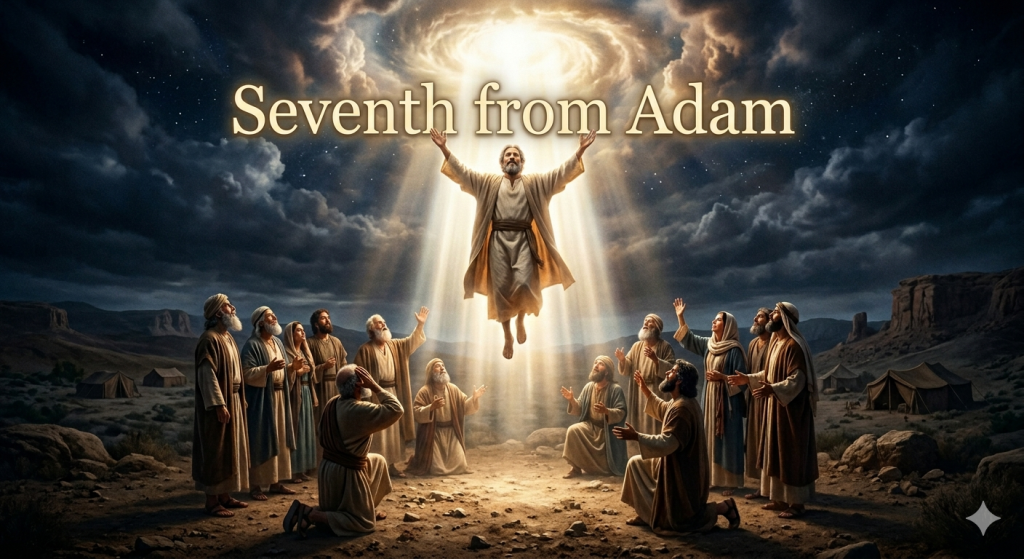
Then, we arrive at the seventh generation from Adam: Enoch.
In the ancient Near Eastern world and throughout the biblical canon, the number seven is never merely a mathematical descriptor.
It is the signature of the Almighty, the number of divine perfection, covenantal completion, sacred rest, and spiritual fullness.
By structurally placing Enoch as the seventh patriarch in the line of Adam, the author signifies that Enoch’s life represents the ultimate “completion” or fullness of what human existence was originally intended to be: unbroken, intimate fellowship with the Living God.
The text abandons the established literary formula to describe Enoch’s life:
Genesis 5:22-24 LSB Then Enoch walked with God 300 years after he became the father of Methuselah, and he became the father of other sons and daughters. (23) So all the days of Enoch were 365 years. (24) Enoch walked with God; and he was not, for God took him.“
The phrase “walked with God” (Hebrew: vayithhalech Chanoch eth-haElohim) implies an ongoing, deep, habitual intimacy.
It describes a life that was completely aligned with the Creator’s character, will, and presence.
Because of this radical alignment, the relentless music of Genesis 5 suddenly pauses. The text refuses to utter the crushing final words for Enoch. He does not die. Instead, “he was not, for God took him.”
This is a stunning manifestation of divine sovereignty that completely defies the established laws of the created order.
Every rule of physics, biology, and theology up to this point dictated that Enoch must return to the dust from which his ancestor Adam was formed.
No human king, no ancient army, no scientific advancement, and no created being has ever possessed the inherent capability to simply bypass the reality of death. Left to our own strength, humanity is entirely helpless against the grave.
And yet, God steps into time and demonstrates that He is not bound by the rules of the curse, because He is the Author of life.
In a single, sovereign act, God overrides the physical consequences of the Fall and snatches Enoch into eternity alive.
This act of divine translation (Hebrew: laqach, meaning “to take, receive, or fetch”) was a cosmic proclamation to a watching world.
It demonstrated that death does not hold the final script over human history. It proved that Yahweh retains absolute, unvarnished ownership over human destiny, and that the final word over humanity will not be spoken by the dust of the earth, but by the breath of the Creator.
IV. The Continuous Narrative: From Genesis to Revelation
When we understand Enoch not as an isolated theological anomaly, but as a deliberate prophetic signpost, we begin to see how Genesis 5 commentary initiates a continuous, majestic narrative thread that runs seamlessly from Creation to the final consummation of history.
Enoch functions as the great historical forerunner of a grand biblical pattern.
Centuries after Enoch was taken, God would perform the exact same sovereign miracle in the life of the prophet Elijah. As recorded in 2 Kings 2, Elijah, another man who stood as a solitary, uncompromising prophetic voice against a highly corrupt, apostate generation, is suddenly snatched up to heaven in a whirlwind by a chariot of fire, completely bypassing the physical experience of death.
Both Enoch and Elijah were living prophecies, physical types, and shadows pointing directly to the ultimate manifestation of God’s majesty channelled into a single human life: Jesus Christ.
However, the progression from Enoch to Christ highlights the escalating glory of God’s redemptive power:
- Enoch and Elijah were rescued from death; they were snatched away before the grave could claim them, demonstrating God’s authority to preserve a righteous remnant from the presence of cosmic decay.
- Jesus Christ, the ultimate Seventh, the perfect completion of the divine line, did not bypass the grave. Instead, He sovereignly chose to step directly into the jaws of death. He allowed the full weight of the curse of Genesis 5 to crush Him on the cross of Calvary. But because He was the sinless Son of God, the grave could not hold Him. He broke the hinges of death from the inside out, rising victorious on the third day.
Where Enoch showed that God could evade death, Christ proved that God had completely conquered it.
Furthermore, this theological thread of “seven”, initiated by Enoch as the seventh from Adam, reaches its ultimate apocalyptic fulfilment in the Book of Revelation.
The entire book of Revelation is structured around the execution of divine completion and the final purging of the cosmic curse, systematically meted out through the framework of sevens:
7 Churches —> 7 Seals —> 7 Trumpets —> 7 Bowls of Judgment, all completing at the same time on Christ’s return.
Just as Enoch stood at the seventh position of the genealogy to signal a divine interruption before the judgment of the Flood, so too does the cosmic history of the earth march toward a final, absolute “seventh” where the mystery of God is completed, the curse of Eden is permanently revoked, and the new creation is ushered in.
Genesis 5 commentary sets this entire panoramic trajectory in motion.
It establishes that God’s redemptive timeline is meticulously ordered, perfectly sealed, and completely insulated from human failure or historical chaos.
V. The First and the Best: The Lesson of Cain and Abel Reflected
The sovereign elevation of Enoch also serves as a stark historical commentary on the fundamental spiritual lesson that humanity was supposed to learn at the dawn of history: the absolute necessity of offering God our first and our best.
This principle was violently introduced in Genesis 4 through the narrative of Cain and Abel.
Abel brought to God the firstlings of his flock, the prime, the fat portions, the absolute best of his labour, reflecting a heart of total surrender, faith, and recognition of God’s supreme worth.
Cain, conversely, brought an ordinary offering from the fruit of the ground, a casual token of his labour that lacked the essential posture of faith and sacrificial primacy.
God looked with favour upon Abel and his offering, but upon Cain and his offering, He did not look with favour.
Enoch’s life is the ultimate, mature manifestation of Abel’s offering.
Enoch did not merely give God a token of his time, a portion of his wealth, or a ritualistic nod on the Sabbath. Enoch gave God his entire life.
His daily walk, his thoughts, his breath, and his prophetic ministry were an unreserved offering of his absolute first and best to the Creator.
The glory of God is uniquely magnified when He channels His infinite majesty into a human life that has been completely surrendered to Him in this manner.
By publicly honouring Enoch’s radical devotion through the miracle of translation, God showed all subsequent generations that there is only one way to true life, and that is the path of absolute surrender.
God does not accept a divided heart.
He demands the first place, and when a human being aligns their life with that sovereign demand, they become a vessel through which the impossible, transcendent power of God is displayed to the world.
VI. Looking Forward to Genesis 6: The Modern Parallels of the Remnant
Finally, Genesis 5 commentary serves as a sharp prophetic pivot, pointing directly to the dark, catastrophic narrative of Genesis 6.
The genealogy does not end with Enoch; it concludes with Lamech and the birth of Noah. When Lamech names his son, he utters a desperate prophetic longing:
Genesis 5:29 LSB Now he called his name Noah, saying, “This one will give us rest from our work and from the pain of our hands arising from the ground which Yahweh has cursed.”
Immediately after this cry for relief, the narrative curtain rises on Genesis 6, revealing a world that has descended into absolute moral bankruptcy, spiritual apostasy, and demonic corruption.
The text paints a terrifying portrait of human depravity:
Genesis 6:5 LSB Then Yahweh saw that the evil of man was great on the earth, and that every intent of the thoughts of his heart was only evil continually.
The patience of the Creator reaches its divine limit, and God resolves to execute a decree of total global destruction via the Flood.
Yet, precisely in the shadow of impending doom, the spiritual legacy of Enoch’s walk with God bears miraculous fruit.
Out of the entire teeming, corrupt population of the antediluvian world, the text notes a solitary, brilliant exception:
Genesis 6:8-9 LSB But Noah found favor in the eyes of Yahweh. (9) These are the generations of Noah. Noah was a righteous man, blameless among those in his generations; Noah walked with God.
The parallel is deliberate and breathtaking.
Enoch’s life established the pattern; Noah’s life carried it out amid historical judgment.
Enoch was rescued out of the world before the judgment fell; Noah was sovereignly preserved through the judgment inside the ark. Both men stood as stark, uncompromising witnesses to a culture that had completely abandoned its Creator.
This creates a powerful, convicting parallel for the modern reader.
Today, just as in the days of Noah and Enoch, we live in a culture increasingly preoccupied with its own autonomy, scientific self-sufficiency, and moral redefinition.
And unfortunately, even within the walls of the faith community, we find ourselves chronically distracted. We expend vast amounts of spiritual and intellectual energy squabbling in the dust over the accuracy of ancient manuscripts, debating semantic nuances, and trying to force the infinite, transcendent mysteries of God into the tidy, comfortable boxes of modern rationalism.
We behave like accountants trapped in a cathedral, so busy counting the cracks in the floor tiles that we never lift our heads to look at the glorious stained-glass windows rising above us.
Genesis 5 calls us out of the dust of our intellectual skirmishes.
It stands as a timeless, urgent reminder that the text was not given to satisfy our chronological curiosity or to provide data for our scientific timelines.
It was given to cause us to fall on our faces in worship before a sovereign God who rules over life, history, and death with absolute authority.
The manuscript variants do not alter the divine breathing of the text of Genesis 5 commentary.
Scribes may have clumsily copied numbers over millennia, but they could not dim the glory of the God who breathed those words into existence.
The message remains unshakeable: God is faithful, His covenant line will not be broken by human sin, and He is entirely capable of rescuing His people.
May we stop our small, anxious arguments over the mechanics of the ancient text.
Let us lift our eyes to the horizon, marvel at the transcendent majesty of the Sovereign King, and like Enoch and Noah before us, commit our lives to offering Him our absolute first, our absolute best, and our daily, faithful walk.
VII. Exegetical Appendix: Textual Traditions of Genesis 5 Commentary
To fully understand the background of the manuscript debates mentioned above, it is helpful to examine how the primary ancient textual traditions of Genesis 5 commentary record the lifetimes of the pre-flood patriarchs.
The table below illustrates variations in the ages at the birth of the firstborn son, which directly affect the calculation of the historical timeline.
| Patriarch | Masoretic Text (Hebrew) | Septuagint (LXX – Greek) | Samaritan Pentateuch |
| Adam | 130 years | 230 years | 130 years |
| Seth | 105 years | 205 years | 105 years |
| Enosh | 90 years | 190 years | 90 years |
| Kenan | 70 years | 170 years | 70 years |
| Mahalalel | 65 years | 165 years | 65 years |
| Jared | 162 years | 162 years | 62 years |
| Enoch | 65 years | 165 years | 65 years |
| Methuselah | 187 years | 167 years / 187 years | 67 years |
| Lamech | 182 years | 188 years | 53 years |
| Noah | 500 years | 500 years | 500 years |
| Total Years to Flood | 1,656 Years | 2,242 / 2,262 Years | 1,307 Years |
This variance demonstrates why a rigid chronological calculation inevitably encounters human textual limitations in Genesis 5 commentary, reinforcing the theological truth that the text’s ultimate value lies in its structural and spiritual revelations rather than in strict calendar data.

